
Evaluating AI Pipelines: From LLMs to Real-World Impact
Evaluating AI Pipelines: From LLMs to Real-World Impact
The rapid rise of Large Language Models (LLMs) has shifted the conversation from “Can we build AI?” to “How do we evaluate AI effectively?”
Whether you're working with Retrieval-Augmented Generation (RAG), fine-tuned models, or enterprise chatbots, evaluation is no longer optional—it’s a core part of building reliable AI systems.
Why AI Evaluation Matters
In traditional software, correctness is binary—you either pass tests or you don’t. AI systems are fundamentally different. Outputs are probabilistic, context-dependent, and often subjective.
Without proper evaluation:
Hallucinations go unnoticed
Retrieval quality degrades silently
Model updates break existing workflows
User trust erodes
Evaluation is your guardrail.
A Modern AI Pipeline (What Are We Evaluating?)
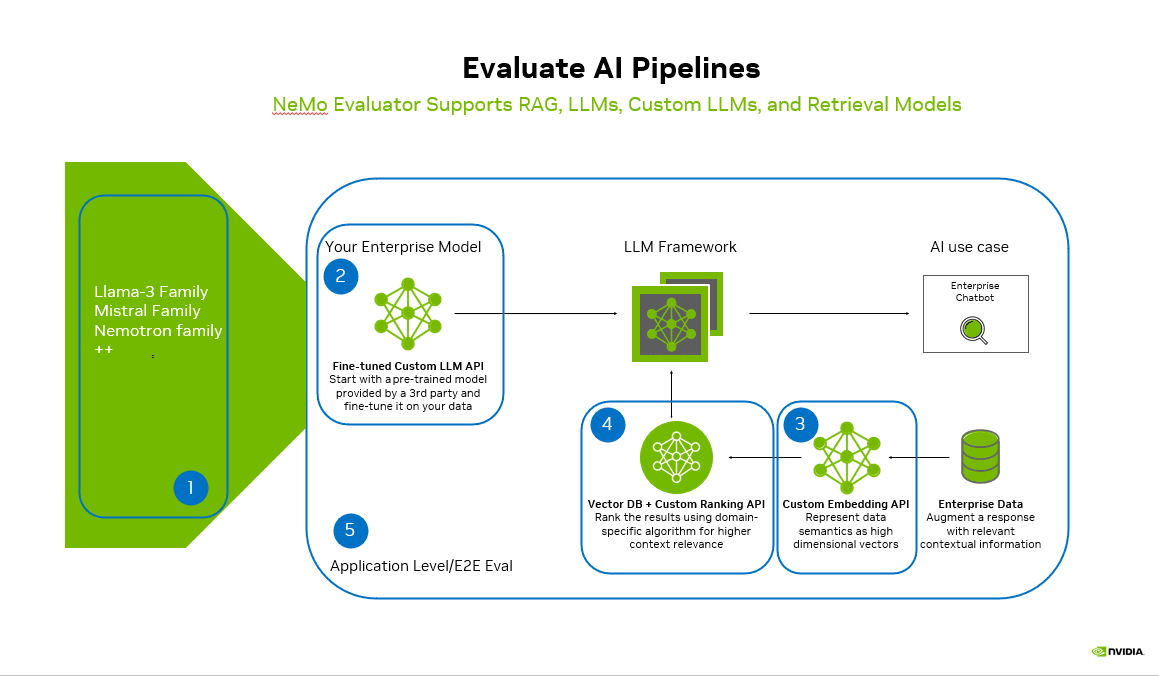
A typical enterprise AI pipeline consists of multiple interconnected components:
Foundation Models
(e.g., Llama, Mistral, Nemotron families)Custom / Fine-tuned LLMs
Adapting base models to domain-specific dataEmbedding Models
Converting text into high-dimensional vectorsVector Databases + Ranking
Retrieving and re-ranking relevant contextApplication Layer
Chatbots, copilots, or enterprise workflows
Each layer introduces its own failure modes—and must be evaluated independently and end-to-end.
Key Evaluation Layers
1. Model-Level Evaluation
Accuracy on domain-specific tasks
Hallucination rate
Instruction-following capability
Latency and cost
2. Retrieval Evaluation (RAG Systems)
Recall@K (Did we retrieve the right documents?)
See AI Voice Agents Handle Real Calls
Book a free demo or calculate how much you can save with AI voice automation.
Precision (How relevant are retrieved chunks?)
Context quality
3. Embedding Evaluation
Semantic similarity performance
Clustering quality
Drift over time
4. Ranking Evaluation
Relevance scoring effectiveness
Context ordering impact on LLM output
5. End-to-End Evaluation
Final answer correctness
Groundedness (Is the answer supported by retrieved data?)
User satisfaction
Common Pitfalls
Evaluating only the LLM, ignoring retrieval
Relying solely on human evaluation (not scalable)
No regression testing after model updates
Ignoring data quality in embeddings
Best Practices
Combine automated + human evaluation
Build golden datasets for benchmarking
Track metrics across every pipeline stage
Use A/B testing for model changes
Continuously monitor production outputs
The Future: Continuous AI Evaluation
Evaluation is moving toward:
Real-time monitoring
Feedback-driven learning loops
Automated guardrails and policy enforcement
Tools like NVIDIA NeMo Evaluator are making it easier to evaluate across the entire AI pipeline—from embeddings to application-level responses.
Final Thoughts
Building AI is no longer the hardest part.
Evaluating, monitoring, and improving it continuously—that’s where real engineering begins.
If you're working on LLM systems today, ask yourself:
What part of your pipeline are you not evaluating yet?
#AI #MachineLearning #LLM #RAG #DataEngineering #MLOps #GenerativeAI
Written by
CallSphere Team
Expert insights on AI voice agents and customer communication automation.
Try CallSphere AI Voice Agents
See how AI voice agents work for your industry. Live demo available -- no signup required.