
In-Context Learning (ICL): How Modern LLMs Learn Without Retraining
In-Context Learning (ICL): How Modern LLMs Learn Without Retraining
In-Context Learning (ICL): How Modern LLMs Learn Without Retraining
Large Language Models (LLMs) have transformed how we build intelligent systems. One of the most powerful capabilities behind their flexibility is In-Context Learning (ICL). Instead of retraining the model every time we want it to perform a new task, we can guide it using examples directly in the prompt.
What is In-Context Learning?
In-Context Learning refers to the ability of a language model to learn patterns from examples provided within the prompt itself, without updating the model’s parameters.
This means the model adapts its responses based on the examples you provide in the same input context.
For AI engineers, this is powerful because it allows rapid experimentation and task adaptation without expensive training pipelines.
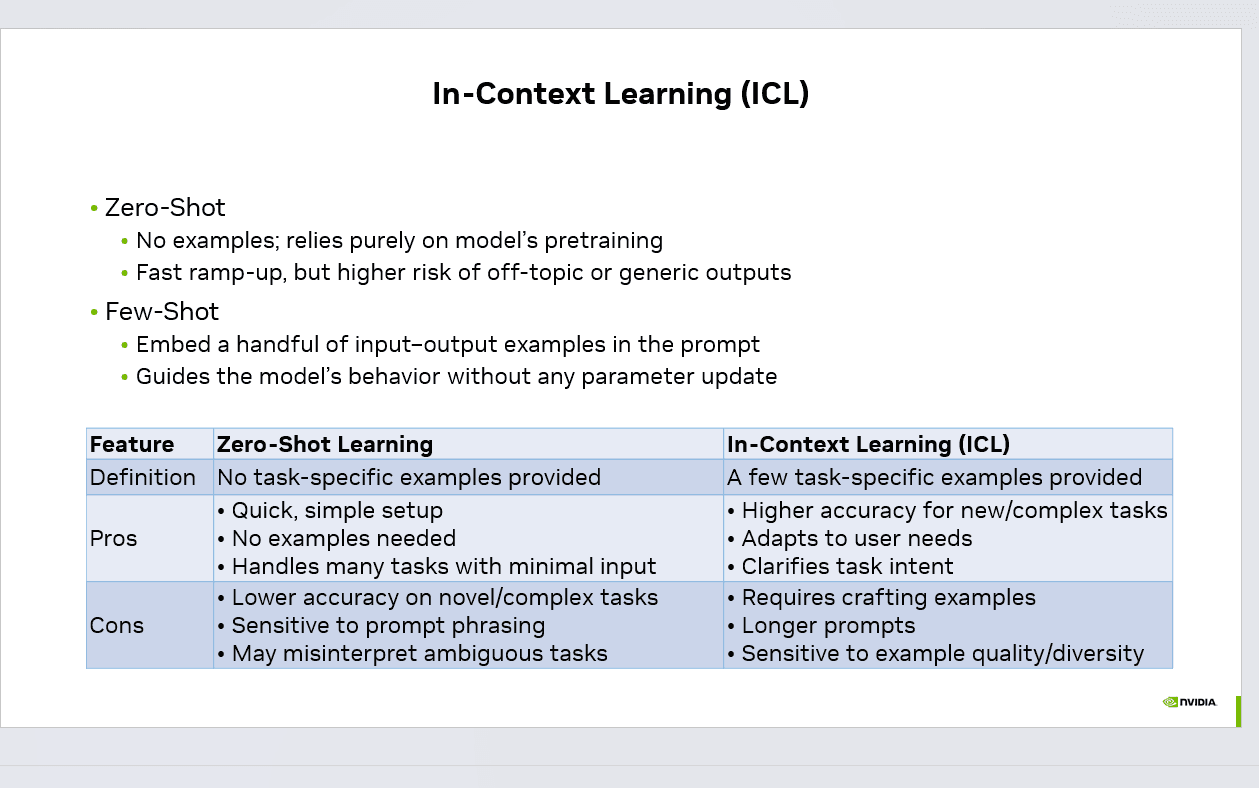
Zero-Shot Learning
Zero-shot learning is the simplest way to use an LLM.
Here, no examples are provided. The model relies entirely on its pretraining knowledge to understand and respond to the task.
Example:
Text: "This product is amazing."
Task: Classify sentiment
Advantages:
Quick and simple setup
No examples needed
Works well for common tasks
Limitations:
Lower accuracy for complex tasks
Sensitive to prompt wording
May produce generic outputs
Few-Shot Learning
Few-shot learning improves performance by adding a few input-output examples in the prompt. These examples guide the model on how to behave.
Example:
Text: I love this movie
Sentiment: Positive
Text: This is the worst service ever
Sentiment: Negative
See AI Voice Agents Handle Real Calls
Book a free demo or calculate how much you can save with AI voice automation.
Text: The product quality is great
Sentiment:
Advantages:
Higher accuracy for complex tasks
Helps clarify task intent
Enables customized outputs
Limitations:
Requires carefully crafted examples
Longer prompts
Output quality depends on example diversity
Why In-Context Learning Matters
ICL is one of the main reasons LLMs are so versatile. Instead of training a new model for every task, developers can simply guide the model with examples inside the prompt.
This enables:
Rapid prototyping of AI applications
Faster experimentation in prompt engineering
Reduced need for costly fine-tuning
Flexible task adaptation across domains
Many modern systems such as AI agents, chatbots, document analysis tools, and coding assistants rely heavily on in-context learning to improve response quality.
When to Use Each Approach
Use Zero-Shot when:
The task is simple
The model already understands the domain
Speed and simplicity matter
Use Few-Shot / In-Context Learning when:
The task is complex or ambiguous
You need structured outputs
You want more consistent responses
Final Thoughts
In-Context Learning is one of the most practical techniques in modern AI development. With just a few well-designed examples, we can guide powerful models to perform new tasks without retraining.
As LLM capabilities continue to evolve, prompt design and example selection will remain critical skills for AI engineers building real-world intelligent systems.
What are some interesting ways you’ve used in-context learning in your projects?
#AI #LLM #MachineLearning #PromptEngineering #GenerativeAI #ArtificialIntelligence
Admin
Expert insights on AI voice agents and customer communication automation.
Try CallSphere AI Voice Agents
See how AI voice agents work for your industry. Live demo available -- no signup required.