
Massive Multitask Language Understanding (MMLU) benchmark evaluates general knowledge and reasoning
Massive Multitask Language Understanding (MMLU) benchmark evaluates general knowledge and reasoning
Massive Multitask Language Understanding (MMLU): How Large Language Models Are Evaluated
Introduction
Evaluating large language models (LLMs) requires more than checking whether they can generate fluent text. We need structured benchmarks that test reasoning, factual knowledge, and subject diversity. One of the most widely used benchmarks for this purpose is MMLU (Massive Multitask Language Understanding).
MMLU measures how well a model performs across a wide range of academic and professional subjects using multiple-choice questions.
What is MMLU?
MMLU is a benchmark designed to evaluate a model’s general knowledge and reasoning ability across diverse domains. It includes questions from subjects such as:
flowchart TD
    START["Massive Multitask Language Understanding MMLU ben…"] --> A
    A["Introduction"]
    A --> B
    B["What is MMLU?"]
    B --> C
    C["How the MMLU Evaluation Process Works"]
    C --> D
    D["Why Logits-Based Evaluation Matters"]
    D --> E
    E["What MMLU Actually Measures"]
    E --> F
    F["Strengths of MMLU"]
    F --> G
    G["Limitations of MMLU"]
    G --> H
    H["Why MMLU Is Important in AI Research"]
    H --> DONE["Key Takeaways"]
    style START fill:#4f46e5,stroke:#4338ca,color:#fff
    style DONE fill:#059669,stroke:#047857,color:#fff
Mathematics
Computer Science
Physics
Law
Medicine
History
Economics
Philosophy
The benchmark spans dozens of subject areas, making it a strong indicator of broad intelligence rather than narrow specialization.
How the MMLU Evaluation Process Works
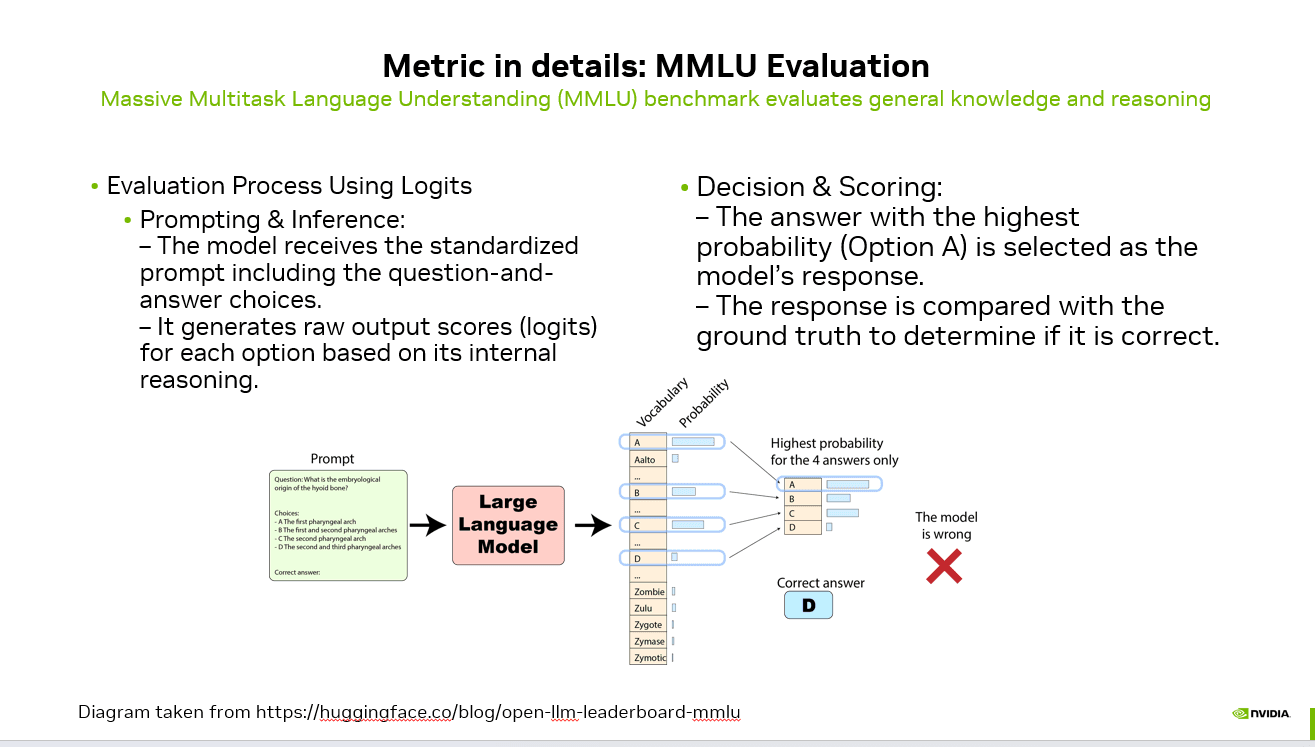
1. Prompting the Model
The model receives a standardized prompt that includes:
A question
Four answer choices (A, B, C, D)
Example format:
Question: What is X?
A) Option 1
B) Option 2
C) Option 3
D) Option 4
The correct answer is known beforehand (ground truth), but the model does not see it.
2. Logits Generation
Instead of directly outputting the final answer, the model internally produces logits.
Logits are raw, unnormalized scores representing how likely each answer choice is according to the model.
For example:
OptionLogit ScoreA2.3B1.1C0.4D3.2
These logits are then converted into probabilities using a softmax function.
3. Decision Rule
The evaluation system selects the answer with the highest probability.
If option D has the highest probability, the model’s prediction becomes:
Predicted Answer: D
4. Scoring
The predicted answer is compared with the correct answer (ground truth).
See AI Voice Agents Handle Real Calls
Book a free demo or calculate how much you can save with AI voice automation.
If they match → the model gets 1 point.
If they do not match → the model gets 0 points.
Accuracy is calculated as:
Accuracy = (Number of Correct Answers / Total Questions) × 100%
Why Logits-Based Evaluation Matters
Using logits ensures:
Objective comparison
No reliance on verbose explanations
Consistent scoring across models
Reproducible evaluation methodology
This prevents ambiguity in answer interpretation and focuses strictly on measurable performance.
What MMLU Actually Measures
MMLU evaluates:
flowchart LR
    S0["1. Prompting the Model"]
    S0 --> S1
    S1["2. Logits Generation"]
    S1 --> S2
    S2["3. Decision Rule"]
    S2 --> S3
    S3["4. Scoring"]
    style S0 fill:#4f46e5,stroke:#4338ca,color:#fff
    style S3 fill:#059669,stroke:#047857,color:#fff
Factual knowledge
Multi-step reasoning
Domain transfer ability
Generalization across subjects
It does not measure:
Creativity
Open-ended writing quality
Long-form coherence
Conversational ability
Thus, MMLU is a strong academic reasoning benchmark, but not a complete measure of intelligence.
Strengths of MMLU
Broad subject coverage
Standardized multiple-choice format
Easy comparison between models
Clear, interpretable scoring (accuracy-based)
Limitations of MMLU
Multiple-choice structure may allow guessing
Does not evaluate long-form reasoning depth
Limited real-world task simulation
May favor models trained on similar datasets
Why MMLU Is Important in AI Research
MMLU has become a common benchmark in research papers and model leaderboards. High performance on MMLU indicates that a model has:
Strong knowledge representation
Effective reasoning capability
Cross-domain understanding
Because it spans many disciplines, it is considered a good proxy for general academic intelligence.
Final Thoughts
MMLU provides a structured and objective way to evaluate large language models across a wide range of subjects. By using logits-based decision making and strict accuracy scoring, it ensures consistent benchmarking across models.
However, while MMLU is powerful, it should be combined with other benchmarks to fully evaluate reasoning, creativity, safety, and real-world performance.
In modern AI evaluation pipelines, MMLU remains one of the foundational benchmarks for assessing general knowledge and reasoning strength.
#MMLU #MassiveMultitaskLanguageUnderstanding #LLMEvaluation #ArtificialIntelligence #MachineLearning #LargeLanguageModels #AIResearch #ModelBenchmarking #DeepLearning #GenerativeAI
Written by
CallSphere Team
Expert insights on AI voice agents and customer communication automation.
Try CallSphere AI Voice Agents
See how AI voice agents work for your industry. Live demo available -- no signup required.