
Showcasing LLM Performance: How Research Papers Present Evaluation Results
Showcasing LLM Performance: How Research Papers Present Evaluation Results
Showcasing LLM Performance: How Research Papers Present Evaluation Results
Building a high-performing LLM is only part of the challenge. Equally important is how its performance is communicated. Leading research papers do not rely on claims — they rely on structured benchmarks, transparent methodology, and measurable comparisons.
Here is how strong evaluation reporting is typically presented.
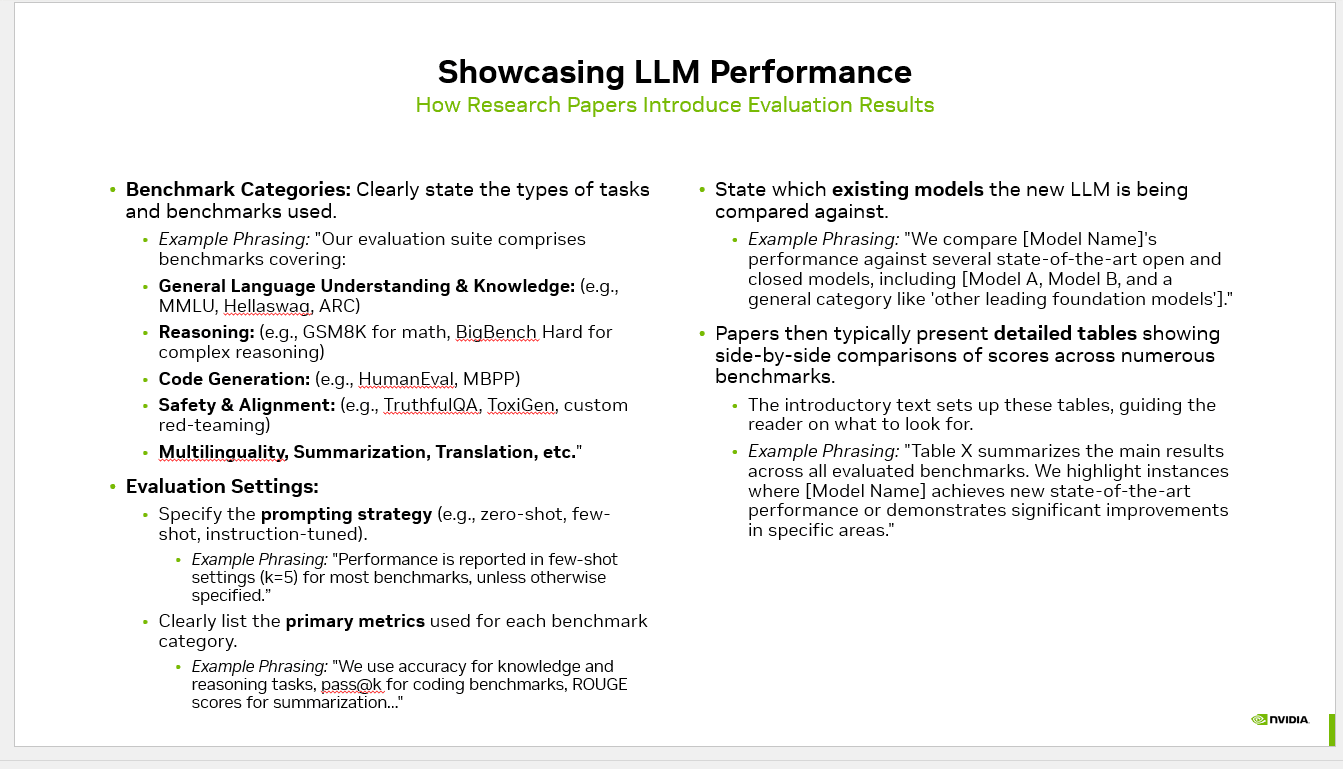
1. Clearly Defined Benchmark Categories
Top-tier research begins by explicitly defining what is being evaluated. Benchmarks are grouped into well-structured categories to ensure clarity and reproducibility.
Common categories include:
General Language Understanding & Knowledge
(e.g., MMLU, HellaSwag, ARC)
Reasoning
(e.g., GSM8K, BigBench Hard)
Code Generation
(e.g., HumanEval, MBPP)
Safety & Alignment
(e.g., TruthfulQA, ToxiGen, red-teaming datasets)
Multilinguality, Summarization, Translation, and related tasks
This structured categorization builds credibility and allows others to reproduce results with confidence.
2. Transparent Evaluation Settings
Performance metrics without context are meaningless. Strong research papers clearly document the evaluation setup.
flowchart TD
    START["Showcasing LLM Performance: How Research Papers P…"] --> A
    A["1. Clearly Defined Benchmark Categories"]
    A --> B
    B["2. Transparent Evaluation Settings"]
    B --> C
    C["3. Rigorous Comparison Against Existing…"]
    C --> D
    D["Why This Matters"]
    D --> DONE["Key Takeaways"]
    style START fill:#4f46e5,stroke:#4338ca,color:#fff
    style DONE fill:#059669,stroke:#047857,color:#fff
They specify:
Prompting strategy (zero-shot, few-shot, instruction-tuned)
Number of examples used (e.g., k=5 for few-shot)
Primary metrics reported for each task category
Commonly used metrics include:
See AI Voice Agents Handle Real Calls
Book a free demo or calculate how much you can save with AI voice automation.
Accuracy (knowledge and reasoning tasks)
Pass@k (coding benchmarks)
ROUGE / BLEU (summarization and translation)
This level of transparency prevents misleading comparisons and ensures fairness across models.
3. Rigorous Comparison Against Existing Models
No model exists in isolation. Research papers position new LLMs against:
Leading open-source foundation models
Commercial closed-source systems
Previous internal model versions
Results are presented in detailed, side-by-side tables that enable objective comparison.
Strong reporting also highlights:
Areas achieving state-of-the-art performance
Domains showing significant improvement
Known limitations and trade-offs
This balanced presentation strengthens trust and technical credibility.
Why This Matters
Structured benchmarking, standardized metrics, and transparent comparisons transform evaluation from opinion into engineering.
For teams building AI products, the takeaway is clear:
Define benchmark categories upfront
Standardize evaluation settings
Track consistent, task-appropriate metrics
Compare against strong and relevant baselines
Moving from “It looks good” to “It is measurably better” is what separates experimentation from production-grade AI.
#AI #MachineLearning #LLM #AIEvaluation #AIResearch #GenerativeAI #MLOps #AIEngineering #ModelBenchmarking
Written by
CallSphere Team
Expert insights on AI voice agents and customer communication automation.
Try CallSphere AI Voice Agents
See how AI voice agents work for your industry. Live demo available -- no signup required.