
Unlocking the Potential of LLM Pretraining with Self-Supervised Learning
Understanding LLM Pretraining: The Power of Self-Supervised Learning
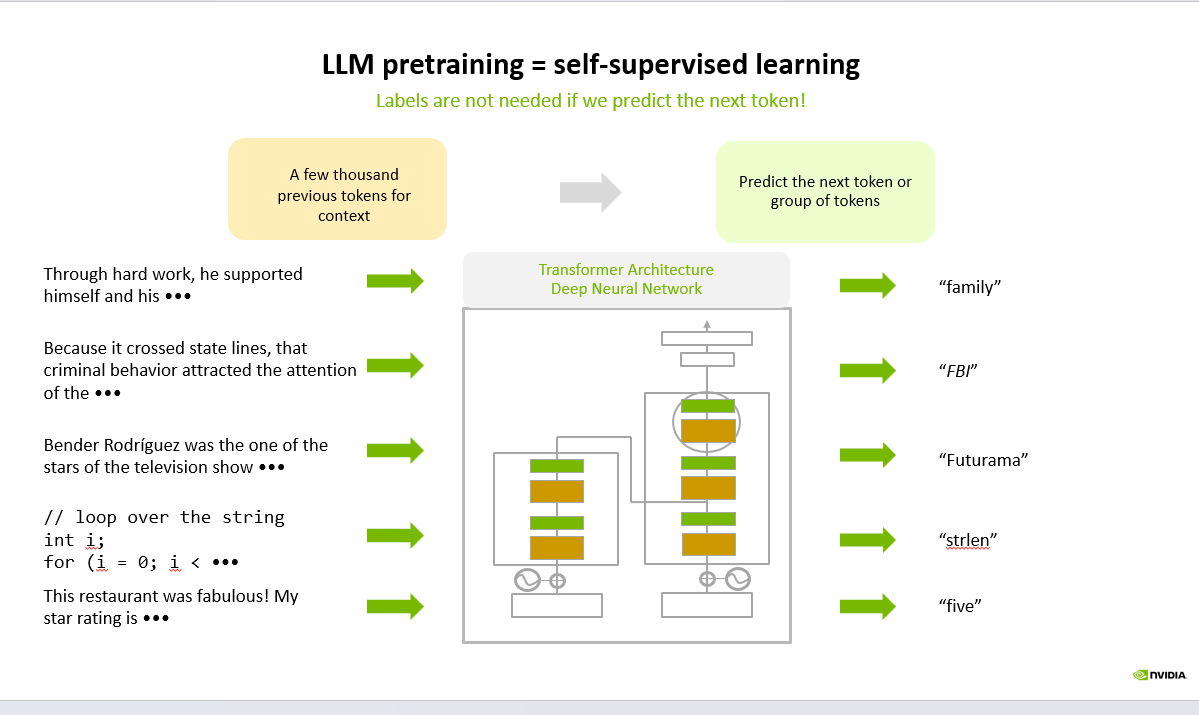
Large Language Models (LLMs) are built on a fundamentally different training paradigm compared to traditional machine learning systems. Instead of relying on manually labeled datasets, they leverage self-supervised learning—a method where the data itself provides the learning signal.
At the core of this approach is a simple objective: predict the next token in a sequence.
Given a partial sentence, the model learns to infer what comes next based on patterns observed across vast amounts of text. For example:
“Through hard work, he supported himself and his …” → family
“Because it crossed state lines, the case was handled by the …” → FBI
“Bender Rodríguez is a character from …” → Futurama
See AI Voice Agents Handle Real Calls
Book a free demo or calculate how much you can save with AI voice automation.
Each prediction task becomes a training signal, eliminating the need for explicit human annotations.
Why this approach matters
First, it enables massive scalability. Since the internet and enterprise data sources contain enormous volumes of unlabeled text, models can be trained on diverse and rich datasets without costly labeling processes.
Second, it leads to strong generalization. By learning language patterns, context, and relationships across domains, LLMs develop capabilities that transfer across tasks such as question answering, summarization, and code generation.
Third, it forms the foundation for downstream alignment. Techniques like instruction tuning and reinforcement learning build on this pretrained base to make models more useful and aligned with human intent.
The bigger picture
Self-supervised pretraining is not just an optimization trick; it is the reason modern AI systems can understand and generate human-like language at scale. By transforming raw text into structured knowledge through prediction, LLMs effectively learn how language—and to some extent, reasoning—works.
As AI systems continue to evolve, this paradigm remains central to building more capable, adaptable, and efficient models.
#AI #MachineLearning #LLM #GenerativeAI #DeepLearning #ArtificialIntelligence #DataScience #NLP #TechInnovation #AIEngineering
Written by
CallSphere Team
Expert insights on AI voice agents and customer communication automation.
Try CallSphere AI Voice Agents
See how AI voice agents work for your industry. Live demo available -- no signup required.