
What is Controlled Evaluation for Large Language Models?
Assessing LLM Performance: Strategies to Evaluate and Improve Your App.
In today’s AI race, most teams optimize for impressive demos.
Very few optimize for measurable performance.
If you’re building AI-powered products, controlled evaluation is not optional — it’s your competitive advantage.
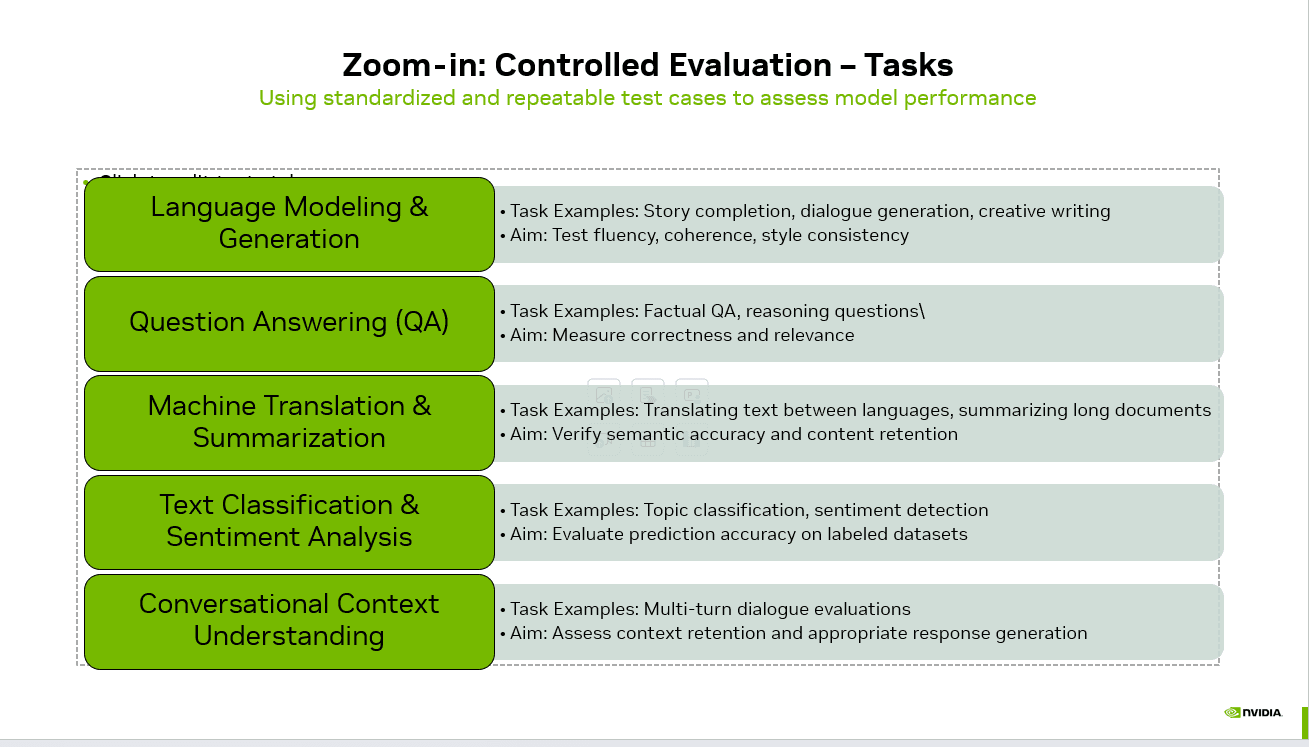
Controlled evaluation means using standardized, repeatable test cases to assess model performance across clearly defined tasks. Instead of relying on subjective judgment (“it sounds good”), you measure structured outcomes.
Let’s break down the core task categories every serious AI team should evaluate.
1️⃣ Language Modeling & Generation
Task Examples:
Story completion
Dialogue generation
Creative writing
What You’re Testing:
Fluency
Coherence
Style consistency
Creative generation often looks impressive in demos. But in production, you need consistency. Can the model maintain tone across 1,000 outputs? Does it drift stylistically? Does it hallucinate details?
Controlled prompts + scoring rubrics = measurable creativity.
2️⃣ Question Answering (QA)
Task Examples:
flowchart TD
    START["What is Controlled Evaluation for Large Language …"] --> A
    A["1️⃣ Language Modeling amp Generation"]
    A --> B
    B["2️⃣ Question Answering QA"]
    B --> C
    C["3️⃣ Machine Translation amp Summarizati…"]
    C --> D
    D["4️⃣ Text Classification amp Sentiment A…"]
    D --> E
    E["5️⃣ Conversational Context Understanding"]
    E --> DONE["Key Takeaways"]
    style START fill:#4f46e5,stroke:#4338ca,color:#fff
    style DONE fill:#059669,stroke:#047857,color:#fff
Factual question answering
Multi-step reasoning questions
What You’re Testing:
Correctness
Relevance
Logical consistency
This is where hallucinations become visible.
Benchmarking factual accuracy and reasoning depth under controlled inputs helps identify whether your system is reliable enough for customer-facing use cases.
3️⃣ Machine Translation & Summarization
Task Examples:
flowchart TD
    CENTER(("LLM Pipeline"))
    CENTER --> N0["Story completion"]
    CENTER --> N1["Dialogue generation"]
    CENTER --> N2["Creative writing"]
    CENTER --> N3["Fluency"]
    CENTER --> N4["Coherence"]
    CENTER --> N5["Style consistency"]
    style CENTER fill:#4f46e5,stroke:#4338ca,color:#fff
Translating text between languages
See AI Voice Agents Handle Real Calls
Book a free demo or calculate how much you can save with AI voice automation.
Summarizing long-form documents
What You’re Testing:
Semantic accuracy
Content retention
Information compression quality
It’s easy for a model to sound fluent while subtly changing meaning. Evaluation frameworks ensure the output preserves intent and key details.
4️⃣ Text Classification & Sentiment Analysis
Task Examples:
Topic classification
Sentiment detection
What You’re Testing:
Prediction accuracy
Precision / recall
Robustness across edge cases
Here, LLMs can be compared against traditional ML baselines. Controlled datasets allow objective performance comparisons.
5️⃣ Conversational Context Understanding
Task Examples:
Multi-turn dialogue evaluation
Context carryover tests
What You’re Testing:
Context retention
Response appropriateness
Instruction adherence
This is critical for AI agents and enterprise assistants. Many systems perform well in single-turn prompts but degrade across longer interactions.
Why This Matters
Without controlled evaluation:
You can’t compare models objectively.
You can’t measure improvements.
You can’t justify production deployment decisions.
You can’t build trust with stakeholders.
With controlled evaluation:
You move from opinion to metrics.
From demo-driven to data-driven.
From experimentation to engineering discipline.
The future of AI development won’t be decided by who builds the flashiest demo.
It will be decided by who measures performance rigorously and improves systematically.
If you're building with LLMs in 2026, ask yourself:
👉 Do you have a structured evaluation pipeline — or just impressive screenshots?
#AI #LLM #ArtificialIntelligence #MachineLearning #AIEngineering #GenAI #ModelEvaluation #DataDriven #AIProductDevelopment
Written by
CallSphere Team
Expert insights on AI voice agents and customer communication automation.
Try CallSphere AI Voice Agents
See how AI voice agents work for your industry. Live demo available -- no signup required.