
How Do You Really Know If Your LLM Is Good Enough? A Guide to Controlled Evaluation Metrics
How Do You Really Know If Your LLM Is Good Enough? A Guide to Controlled Evaluation Metrics
If you're building, fine-tuning, or deploying large language models, there's one question that should keep you up at night: How do you measure what "good" actually looks like?
Vibes-based evaluation doesn't scale. Neither does cherry-picking impressive outputs for a demo. What you need is controlled evaluation — standardized, repeatable test cases that give you an honest picture of model performance.
Here's a breakdown of the quantitative metrics that matter, and when to use each one.
Standard Accuracy Metrics
These are your bread and butter for classification and question-answering tasks:
Accuracy tells you the percentage of correct predictions overall. Simple, but can be misleading on imbalanced datasets.
Precision answers: "Of everything the model flagged as positive, how much was actually positive?" Critical when false positives are expensive — think spam detection or medical diagnosis.
Recall answers the inverse: "Of all the actual positives, how many did the model catch?" This is your go-to when missing a true positive is costly.
F1 Score balances precision and recall into a single number. When you can't afford to optimize one at the expense of the other, F1 is your north star.
Language Modeling Metrics
When you're evaluating the model's core language capabilities:
See AI Voice Agents Handle Real Calls
Book a free demo or calculate how much you can save with AI voice automation.
flowchart TD
    START["How Do You Really Know If Your LLM Is Good Enough…"] --> A
    A["Standard Accuracy Metrics"]
    A --> B
    B["Language Modeling Metrics"]
    B --> C
    C["Academic Benchmarks"]
    C --> D
    D["The Bigger Picture"]
    D --> DONE["Key Takeaways"]
    style START fill:#4f46e5,stroke:#4338ca,color:#fff
    style DONE fill:#059669,stroke:#047857,color:#fff
Perplexity measures how well a model predicts a sample of text. Lower perplexity means the model is less "surprised" by the data — a strong indicator of language fluency. It's particularly useful during pre-training and fine-tuning to track whether the model is actually learning.
BLEU and ROUGE are the workhorses of machine translation and summarization evaluation. Both measure n-gram overlap between generated and reference text, but from different angles — BLEU focuses on precision (is the generated text accurate?) while ROUGE focuses on recall (did it capture the key information?).
Academic Benchmarks
These standardized benchmarks let you compare your model against the field:
GLUE/SuperGLUE — Collections of language understanding tasks that test everything from sentiment analysis to textual entailment. SuperGLUE was introduced when models started saturating the original GLUE benchmark.
SQuAD — The Stanford Question Answering Dataset remains a gold standard for evaluating reading comprehension and extractive QA capabilities.
MMLU — Massive Multitask Language Understanding tests knowledge across 57 subjects, from STEM to humanities. It's one of the best proxies for general knowledge and reasoning.
GSM8K — Focused specifically on grade-school math word problems, this benchmark reveals how well your model handles quantitative reasoning and multi-step problem-solving.
The Bigger Picture
No single metric tells the whole story. A model might ace MMLU but hallucinate on domain-specific queries. It might have low perplexity but produce biased outputs. It might crush GSM8K but fail at real-world math applied to your use case.
The key is building an evaluation suite tailored to your deployment context — combining standard metrics with domain-specific benchmarks and qualitative human evaluation.
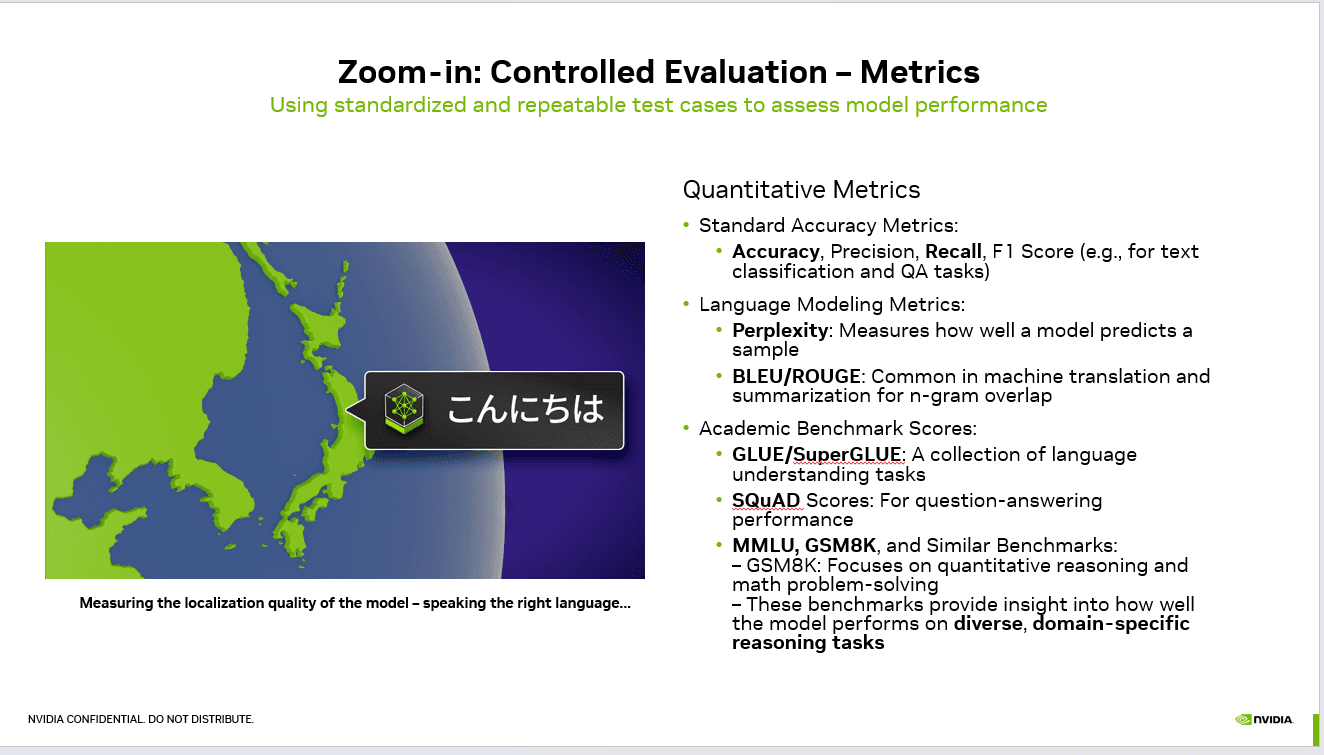
And don't forget localization. If your model serves a global audience, you need to evaluate whether it performs consistently across languages and cultural contexts, not just in English.
The models that win in production aren't the ones with the best benchmark scores. They're the ones that were evaluated honestly.
What evaluation metrics have you found most valuable for your LLM projects? I'd love to hear what's worked (and what hasn't) in the comments.
#LLM #AI #MachineLearning #ModelEvaluation #NLP #DeepLearning #ArtificialIntelligence #MLOps
Written by
CallSphere Team
Expert insights on AI voice agents and customer communication automation.
Try CallSphere AI Voice Agents
See how AI voice agents work for your industry. Live demo available -- no signup required.