
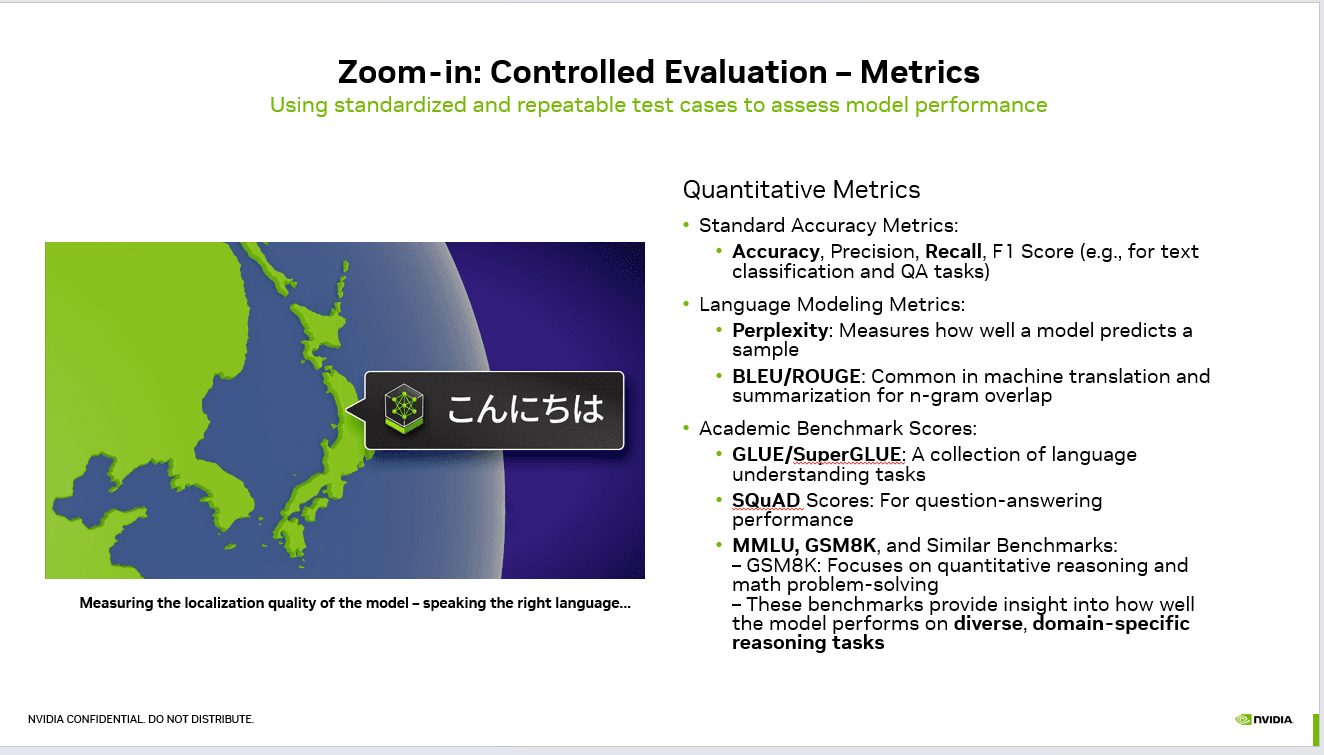
Standardized Test Cases to Assess AI Model Performance
Standardized Test Cases to Assess AI Model Performance
Standardized Test Cases to Assess AI Model Performance
Why Evaluation Matters
As AI systems move from demos to real products, subjective impressions are no longer enough. We need measurable, repeatable, and standardized testing to understand whether a model is actually improving. Controlled evaluation provides exactly that — structured test cases that objectively measure performance across different tasks and domains.
Instead of asking “Does the model feel smarter?”, controlled evaluation asks “Did the model get more correct answers on the same benchmark?”
Core Quantitative Metrics
1. Accuracy Metrics
These are the most common metrics used in classification and question‑answering tasks:
flowchart TD
    START["Standardized Test Cases to Assess AI Model Perfor…"] --> A
    A["Why Evaluation Matters"]
    A --> B
    B["Core Quantitative Metrics"]
    B --> C
    C["What Controlled Evaluation Actually Tel…"]
    C --> D
    D["Practical Impact in Production AI"]
    D --> E
    E["Final Thought"]
    E --> DONE["Key Takeaways"]
    style START fill:#4f46e5,stroke:#4338ca,color:#fff
    style DONE fill:#059669,stroke:#047857,color:#fff
Accuracy – Percentage of correct predictions
Precision – Correct positives among predicted positives
Recall – Correct positives among actual positives
F1 Score – Balance between precision and recall
They help evaluate reliability when the output must be strictly correct — like routing, classification, or intent detection.
2. Language Modeling Metrics
Used when models generate text rather than select labels.
Perplexity
Measures how well a model predicts text. Lower perplexity means the model better understands language structure.
BLEU / ROUGE
Compare generated text with reference text by measuring overlap. Common in translation and summarization tasks.
3. Academic Benchmark Suites
Benchmarks evaluate deeper reasoning rather than surface correctness.
See AI Voice Agents Handle Real Calls
Book a free demo or calculate how much you can save with AI voice automation.
GLUE / SuperGLUE – General language understanding tasks
SQuAD – Question answering comprehension
MMLU – Multi‑domain knowledge and reasoning
GSM8K – Math reasoning and problem solving
These benchmarks reveal whether a model truly understands concepts or only imitates patterns.
What Controlled Evaluation Actually Tells You
Controlled evaluation answers three critical product questions:
flowchart LR
    S0["1. Accuracy Metrics"]
    S0 --> S1
    S1["2. Language Modeling Metrics"]
    S1 --> S2
    S2["3. Academic Benchmark Suites"]
    style S0 fill:#4f46e5,stroke:#4338ca,color:#fff
    style S2 fill:#059669,stroke:#047857,color:#fff
Is the model improving after a new training iteration?
Does performance hold across domains and languages?
Are we optimizing real capability or just changing style?
For example, a conversational AI might sound fluent while failing reasoning tests — benchmarks expose that gap immediately.
Practical Impact in Production AI
In production systems — customer support agents, copilots, or voice assistants — improvements must be measurable. Controlled evaluation prevents regression and enables safe iteration by:
Tracking performance over time
Comparing models objectively
Detecting silent failures
Validating localization quality
Without evaluation, scaling AI becomes guesswork.
Final Thought
AI progress should not be judged by how impressive a demo looks, but by how consistently it performs under the same conditions. Controlled evaluation transforms AI development from experimentation into engineering — measurable, reliable, and repeatable.
#LLM #AI #MachineLearning #ModelEvaluation #NLP #DeepLearning #ArtificialIntelligence #MLOps
Written by
CallSphere Team
Expert insights on AI voice agents and customer communication automation.
Try CallSphere AI Voice Agents
See how AI voice agents work for your industry. Live demo available -- no signup required.